Handwriting Worksheet Maker for Urdu and English Letters
How a handwriting worksheet maker builds Urdu and English letter-tracing practice sheets that preview exactly as they print.
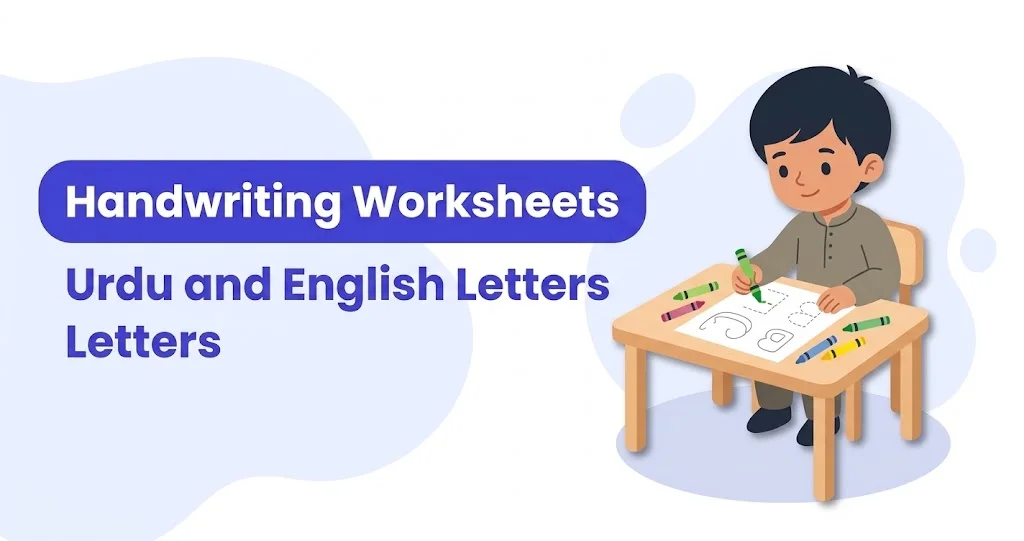
Early classes need a different kind of paper than a matric test - fewer questions, bigger space, and letters to trace rather than answers to circle. A handwriting worksheet maker with a dedicated tracing question type handles this without forcing a nursery or KG paper into a layout built for MCQs.
What a Handwriting Worksheet Actually Needs
A tracing worksheet needs the right-to-left direction and Nastaliq-quality shaping for Urdu letters, clean left-to-right spacing for English letters, and enough space per line that a small hand isn't cramped. The handwriting tracing question type sits alongside lined answers and one-line answers, so a worksheet can move from tracing a letter to writing it independently on the same page as a child progresses.
A good worksheet builder also needs to get the basics of page layout right for small hands: wide line spacing, letters large enough to trace without a magnifying glass, and a print size that doesn't shrink everything down to fit more on one page. These are layout details a teacher shouldn't have to fight a general word processor over just to get one nursery worksheet printed correctly.
Building a Handwriting Worksheet, Step by Step
- Start a new paper, set the language to Urdu, English or Arabic, and choose the handwriting tracing question type.
- Add the letters or words you want traced - Urdu tracing follows the right-to-left, Nastaliq-style layout automatically, English follows left-to-right.
- Add a lined-answer or one-line-answer section afterward for children ready to write the same letters independently rather than only tracing.
- Preview the worksheet - check the line spacing and letter size look right for the class before printing, and choose A4 or Letter depending on what the school uses.
- Print, or save it to your account to duplicate for the next set of letters or the next week's practice sheet.
Because the worksheet lives in the same account as every other paper, a nursery teacher building tracing sheets every week ends up with the same searchable, duplicable history as a matric teacher building test papers - nothing about a handwriting worksheet maker treats early classes as an afterthought.
Mixing Tracing With Other Question Types as Classes Progress
A nursery worksheet might be tracing alone, but by KG or class 1 it often adds a small matching-columns section - matching a traced letter to a picture that starts with it - or a word bank for simple three-letter words. Since tracing, matching columns and word bank all live in the same paper builder, a teacher can grow the worksheet's difficulty term by term without switching tools. Teachers preparing a full class test alongside these worksheets can look at our exam paper maker app guide for building on a phone between classes, and anyone trying this for the first time can make one free before committing to a plan.
Planning a Term of Worksheets Rather Than One at a Time
A nursery or KG teacher usually works through the alphabet or a set of numbers over a full term, not all at once, so it helps to think of the worksheet set as a series from the start: one letter or number focus per sheet, a consistent layout across all of them, and a naming pattern when saving so "Urdu alphabet, week 3" is easy to find later. Building the first worksheet carefully and duplicating it for each new letter is faster than starting fresh every week, since only the traced letters and any matching pictures need to change.
For a mixed-ability class, keeping two versions of the same worksheet - one with tracing only, one with an added lined-answer section for students ready to write independently - lets a teacher hand out the right level without singling anyone out, since both versions share the same layout and only differ in the last section.
Common questions
Does Urdu tracing come out right-to-left automatically?
Yes - setting the paper's language to Urdu switches the layout to right-to-left with Nastaliq-quality letter shaping without any manual adjustment.
Can I mix tracing with regular questions on the same page?
Yes - handwriting tracing, lined answers and one-line answers can all sit in the same paper, so a worksheet can move from tracing into independent writing.
What paper size works best for younger classes?
A4 portrait is the most common choice, giving enough space per line for a young child's handwriting, though Letter is available too if that's what your school prints on.
Some schools print worksheets slightly larger for the youngest classes and drop back to a standard size by class 1 or 2 - switching paper size per worksheet is a setting change, not a rebuild, so this doesn't mean redoing the layout each time. A photocopier that shrinks pages slightly is also worth testing against once, since a worksheet with tight margins can lose a little tracing space in the copying process even when the original file prints correctly.
Most schools end up needing both a test paper builder and a handwriting worksheet maker at some point in the same term, and it's worth having them in one account rather than two separate subscriptions - one login covers the nursery tracing sheet and the matric test paper alike. A handwriting worksheet maker that gets the tracing lines, spacing and script direction right saves more redrawing than any template built for an older class's test paper.